

how to take notes
personal curriculum (2) — a four-step guide to taking notes for the humanities

Taking notes is an integral part of learning. During university, I cycled through many methods, perfecting my stubby numbers for math and loopy chicken-scratch for philosophy. I was once determined to fit every lecture onto one page — a disaster because aesthetics preceded logic in organization.
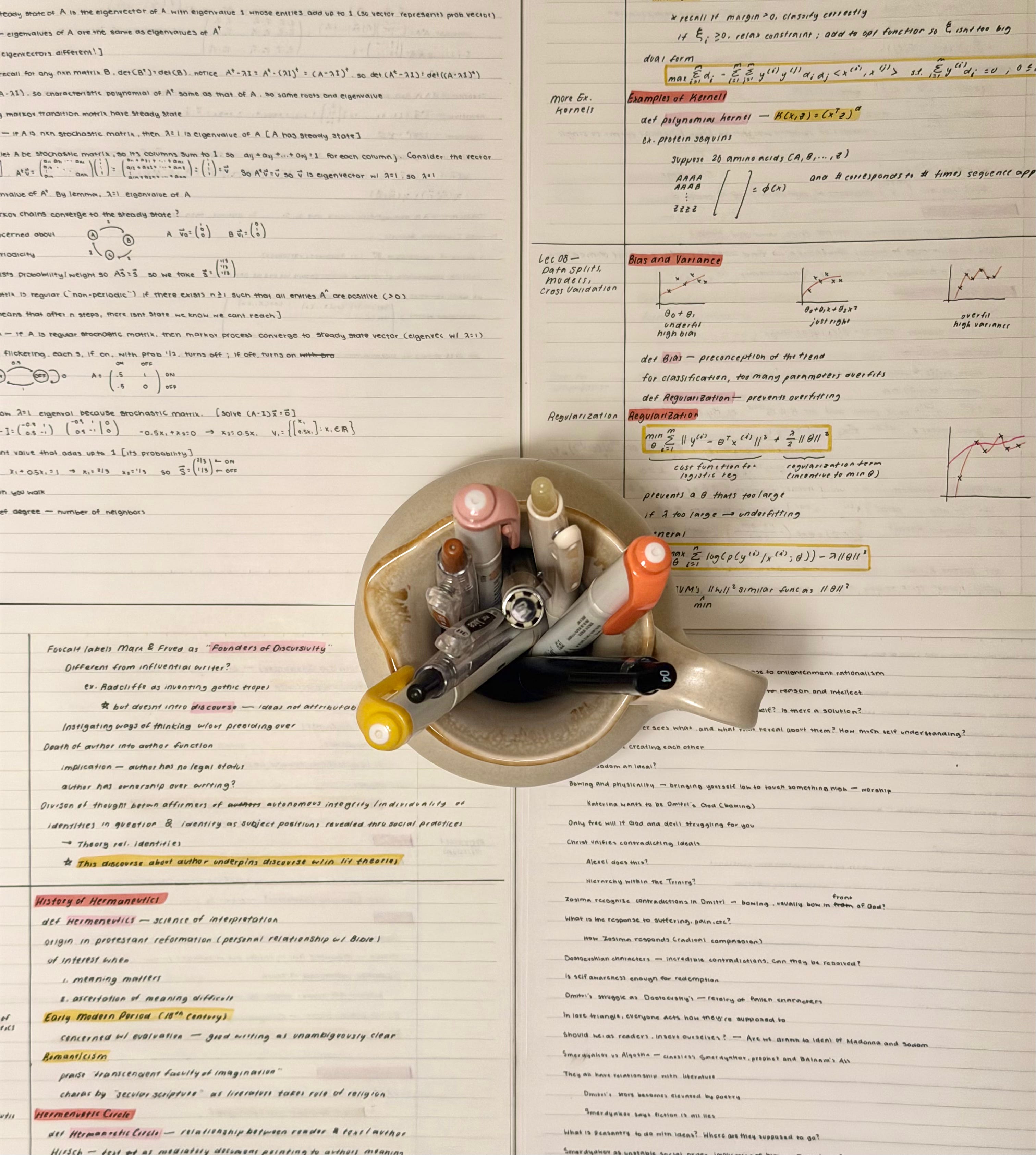
0. decide your “why”
step zero — why are you taking notes?
As with literature, purpose determines form. There’s no “right” reason to take notes. Maybe you want to collect quotes, or to converse with the author. I take notes to capture and condense information for future review. Most students, I’d imagine, would find a similar motivation.
This is step zero because you may decide that you don’t want to take notes. My friend Tom, for instance, doesn’t take notes during lectures because he finds it distracting.
i. supplies
step one — choose supplies that excite you
I once told my English tutor that I didn’t enjoy black-spined Penguin Classics because the pages were too thin and too smooth. “You’ve grown into a true reader,” he said—because physicality shapes the reading experience. Indeed, I prefer to scratch a highlighter against gritty paper (for instance, The Passion According to G.H.) than to glide it along the waxed pages of a Penguin Classic.
With note-taking, your materials are even more important. It is impossible to read over smudged pens, or decipher today’s scribbles from the ghost of yesterday’s notes. I’ve collected stationary since I was five—from collecting corner stores’ glittery gel pens to visiting Ginza Itoya—so I’d consider myself a connoisseur.
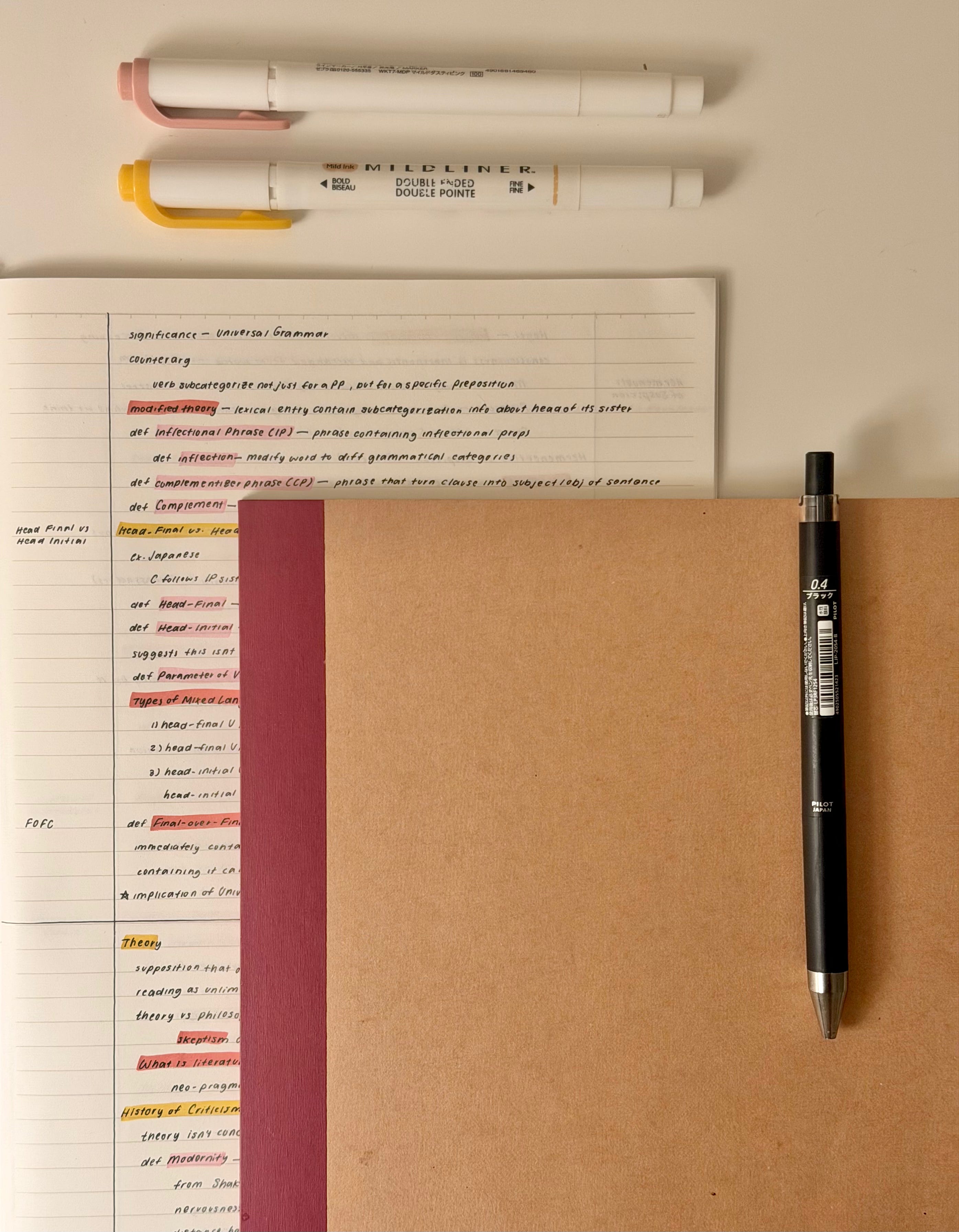
Here is my holy-grail combination:
Notebook: Muji B5
The paper is smooth and absorbs ink instantly—unlike my Moleskin, where pens never seem to dry. It lays flat, and the pages are large enough to accommodate elaborate graphs and long quotations. (Muji’s spiral-bound notebooks, though, face the same problem as Moleskins).
Pen: Pilot Juice Up 0.4mm
This pen glides like an Olympic figure skater on fresh ice. Sometimes, I stare at the ballpoint tip as it marks the page, mesmerized
Highlighters: Zebra Mildliners
I’ve loved these since sixth grade. The colors are gorgeous, and I’ve finessed the technique to minimize bleeding. (Technique: not pressing too hard)
ii. page setup
stsep two — setting up your page
I divide my paper into two sections: headings and notes.
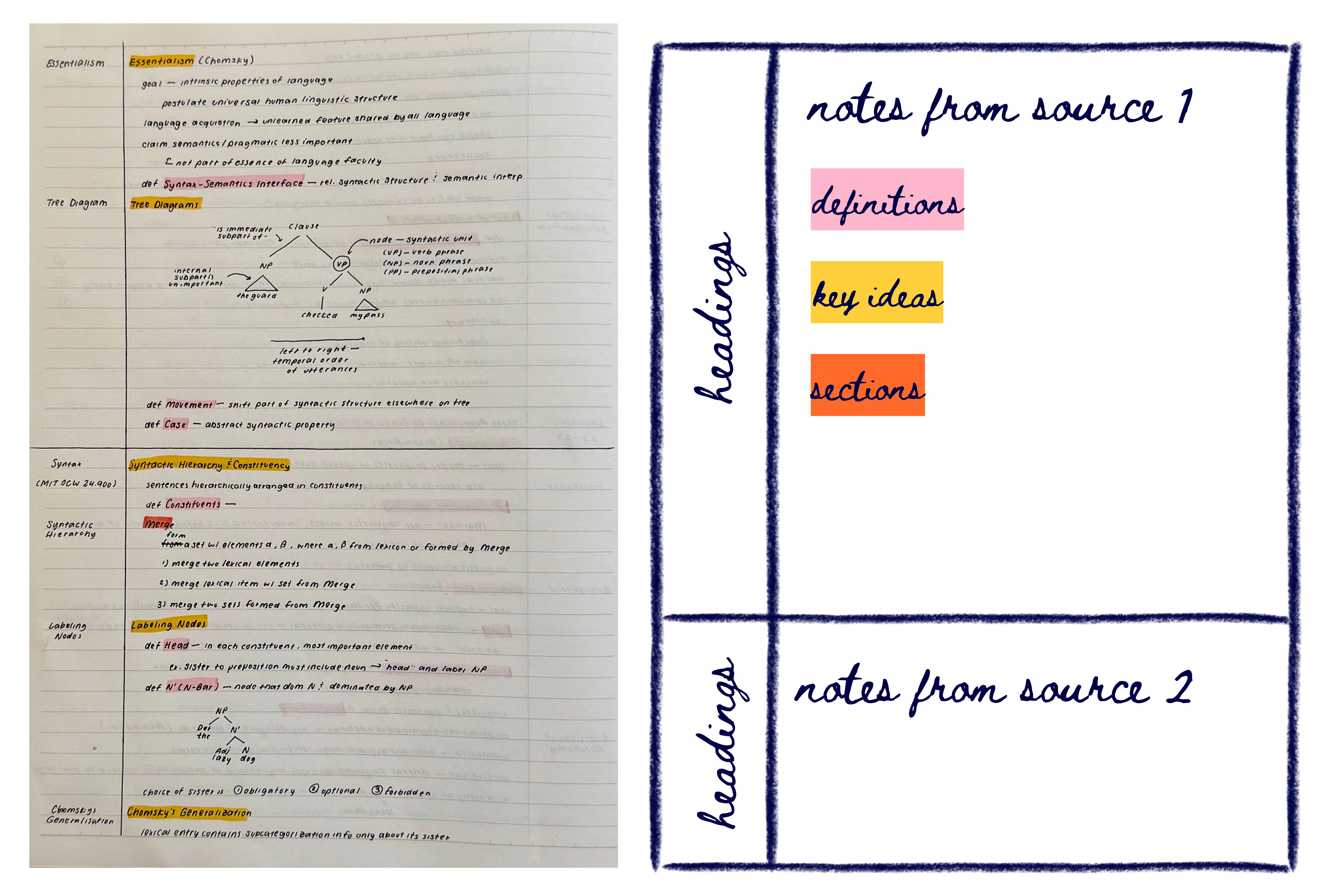
My notebook isn’t dedicated to a particular course, so I will number the pages and construct a table of contents. For that reason, the headings column is also essential for organizing information.
Indentations
I recommend using bullet points. Yet, I omit them as Sally Rooney eliminates her quotation marks—chic, except my objection to bullet points is a nuisance and without literary purpose. Instead, I indent according to the tick marks in my notebook.
My system is as follows:
No indent: major topics, like the title of a chapter. If I sense a topic switch, I leave this line blank and return during the “review” phase (more on this later) to title the section.
One indent: major ideas/thinkers within the topic, like a sub-sections within a chapter.
Every other indent: elaborating on major ideas.
I hope this part is intuitive. I only specified the first two because those are places to which I usually return. Perhaps a helpful analogy is that of a parent-child relationship: indents resemble branches on a family tree.
iii. how to take notes
step three — decide what to write down
What do you write? You may ask.
The answer I’m inclined to give is anything that feels important, but that would be vague and unhelpful. Here is what “feels” important to me.
1. Relevant historical context, or connections to your learning goal
Is there historical context that helps me understand an idea? How does this passage relate to my learning goal?
Movements (such as the Enlightenment or Structuralism) influence the culture and writers of their era. Context, therefore, allows me to understand how ideas emerge.
Also, my larger learning goal involves tracking the history of ideas. I’d encourage you to define an overarching learning goal, and pick out information pertaining to it.
2. Definitions
Would it be helpful to define this word?
Definitions are important. My philosophy professor often stressed that, at the beginning of every paper, you must define key terms. Yet, I toiled over defining “definition.” Is it something undisputed (like the word “tagmemic”)? If a word’s meaning is malleable, should I consider it an “idea” or a “term-to-be-defined”?
Ultimately, I defined words that capture some larger, amorphous thing (such as an idea). To resolve my distinction between objectivity and subjectivity, I include a parenthetical citation of the thinker who specified that definition.
3. Main ideas
What is the text saying?
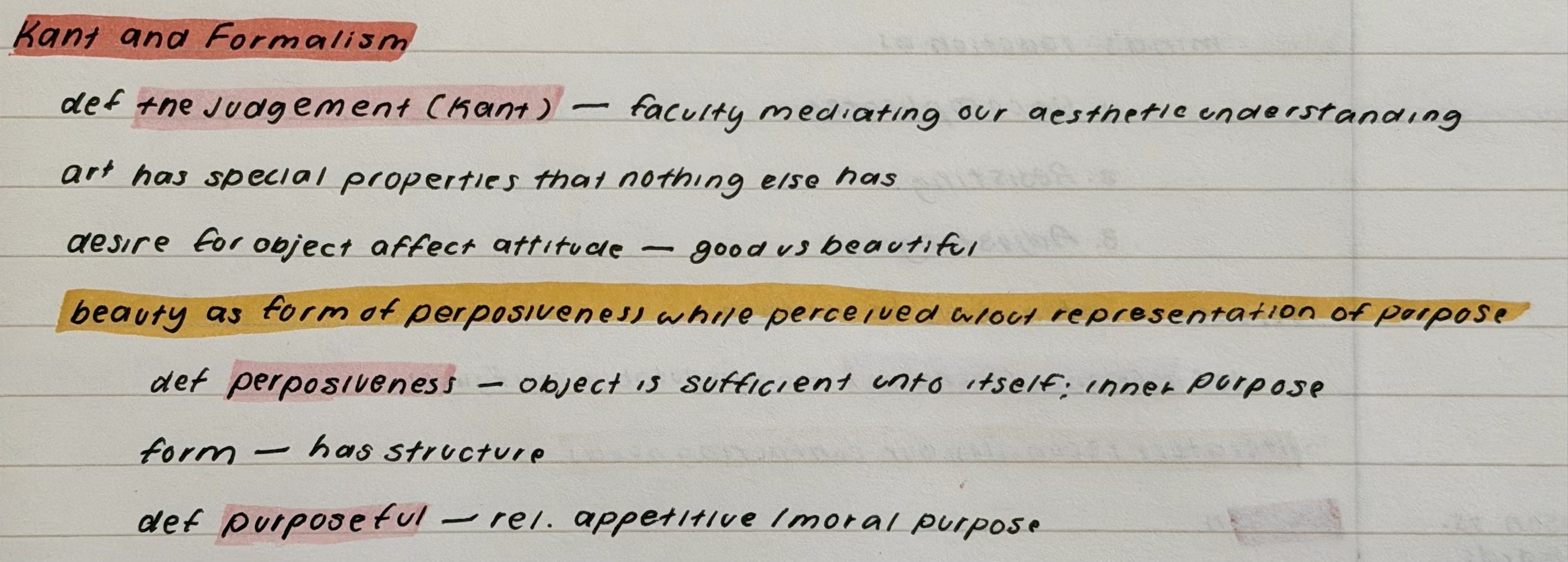
Unlike in a five-paragraph essay, an “x” doesn’t mark the thesis. It is your role to find the main ideas, and I mark them with a star in my notes.
I struggle to define “main idea,” so I’ll offer a trick I use while reading.
A nice trick: finish reading a paragraph before picking up your pen(cil). This way, you’ll understand the bigger picture before picking apart the minutiae.
4. Logical steps in an argument
How did we get to that big idea?
Do you remember writing proofs in eight-grade Geometry? Through “SAS triangle” or the “party-hat theorum,” each numbered line is a logical step from the last until you’ve proven that a triangle, indeed, is a triangle.
Similarly, my philosophy professor uses argument deconstruction. We break down a paper into into its basic assumptions, subsequent claims, and the bold theory that emerges. The benefit is identifying where, exactly, you begin to agree/disagree with the author. It also trains your eye to identifying the purpose of each sentence/idea—like a puzzle, almost.
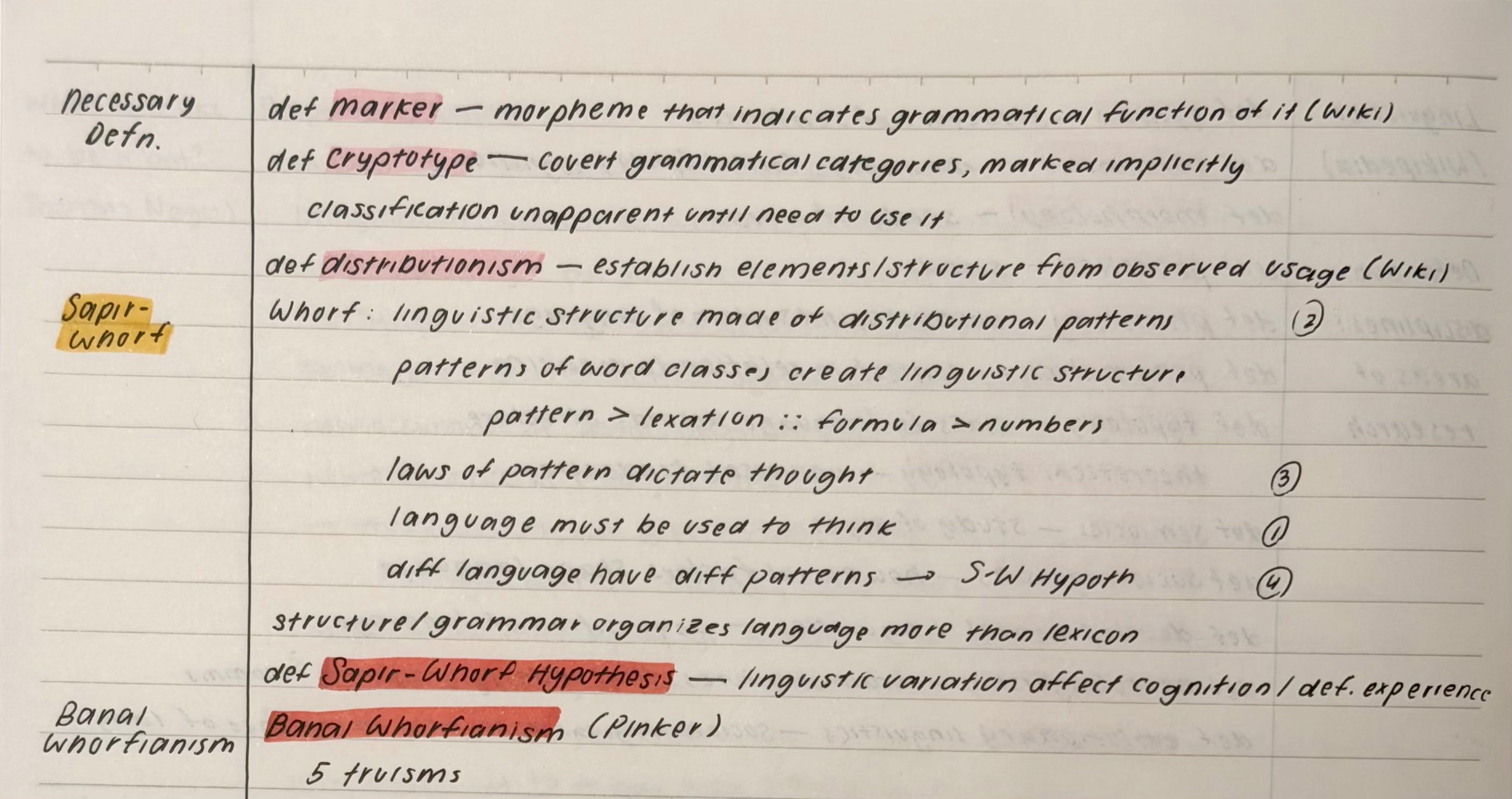
In my notes, I keep track of mini-claims that develop into the “main argument.” In the review phase, I return and number the steps according to logic.
5. Evaluation of ideas
What is strong/weak about an idea?
The simplest example is from machine learning: an algorithm has appropriate applications and weaknesses.
In the humanities—especially secondary sources—evaluation may appear as finding a gaping hole in a thinker’s argument, or a missing piece of evidence that challenges a writer’s theory.
These can be your own thoughts, or that of critics. I’m working on incorporating my thoughts into my notes.
6. Whatever you find interesting
Does anything else speak to you?
Ultimately, these are your notes. You can write down anything that seems interesting—a fun statistic, an elegant phrase, a miscellaneous fact… My favorite is diagrams: they are helpful and aesthetically pleasing.
iv. review
steps 4 — review your notes
If you’ve seen my videos, I highlight and write headings after finishing a chapter. I implement this “review phase” to capture the big picture; otherwise, I get lost in the details. Although it only takes a minute, summing up the lesson (verbally, or in a sentence) solidifies the information in my mind—not doing so is my biggest regret.
Here is what I do during the review phase:
1. highlighting
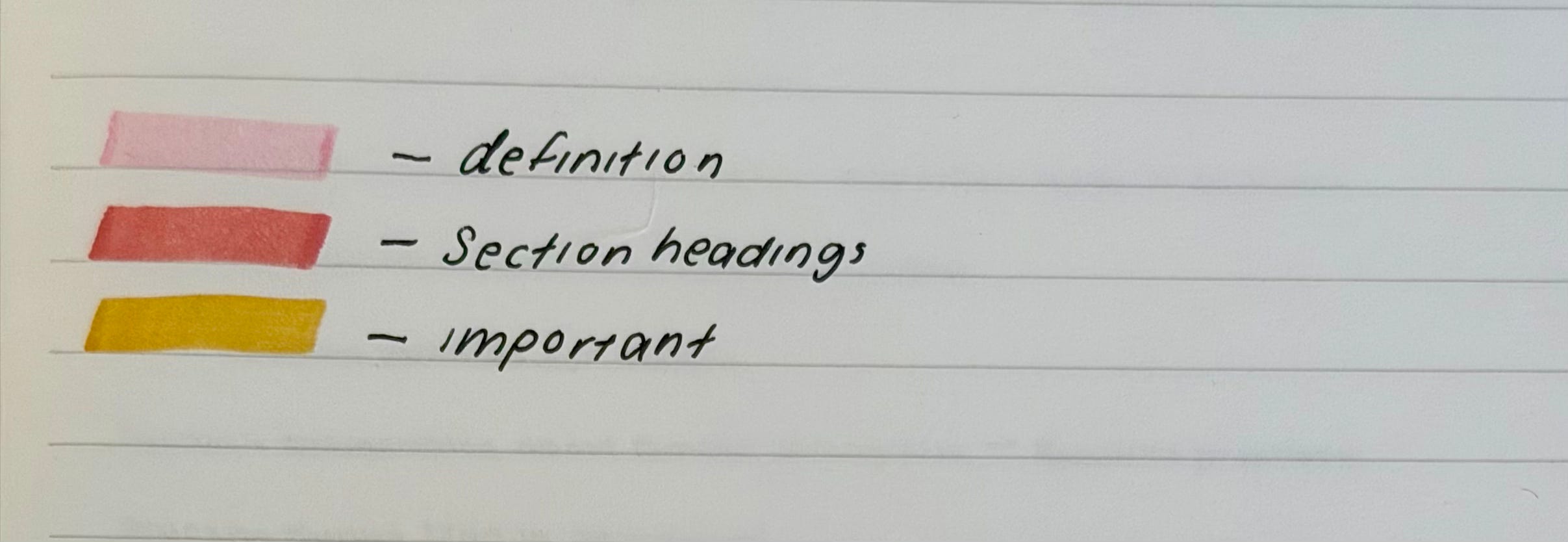
After staring at my semester’s notes—small scratches like an ant colony on paper—I adopted color-coding. Fun colors make reviewing easier, and highlighting is a reward that motivates my learning. I recommend finding a system that works for you.
2. headings
It never made sense to write headings while I watch a lecture. How, in the moment, would I know the main topics? Granted, sometimes I consult the Open Yale Course website for pre-marked sections, but I prefer creating my own headings. This process threads the ideas together in my mind, opening my awareness to previously-unknown connections.
v. conclusion
Here you are—ready to take your own notes!
Thank you for reading!
If this post was helpful, subscribe for more anecdotes and insights from my self-learning journey.